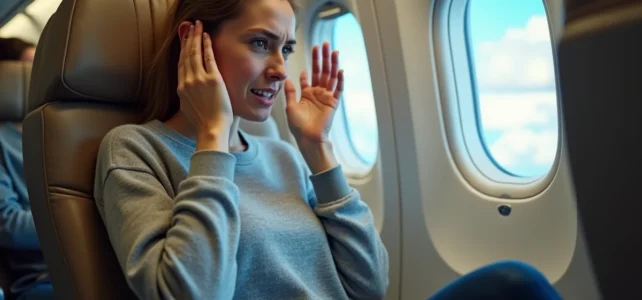
Have you ever felt that dull pressure in your ears when the plane begins its descent? For most passengers, the discomfort disappears within a few minutes. However, for those suffering from endolymphatic hydrops or Meniere’s disease, the pain can last much longer and trigger dizziness or tinnitus. The choice of seat, often seen as a matter of comfort, becomes a real health decision.
Why the seat near the wings worsens hydrops during flight
The cabin of a commercial airplane is pressurized to an altitude equivalent to between 1,800 and 2,400 meters. The air is therefore significantly less dense than at ground level. During ascent and descent, the pressure changes quickly, and the Eustachian tube must open to equalize the middle ear.
In a person with endolymphatic hydrops, the inner ear already contains an excess of fluid (endolymph). The inner ear does not tolerate rapid pressure changes well, which increases the risk of barotrauma in a weakened ear. French aviation doctors emphasize that insufficiently gradual ascents or descents are particularly critical for these patients.
Several ENT teams recommend avoiding seats at or just in front of the wings. The pressure variations there are said to be slightly quicker during maneuvers. This detail, trivial for a passenger without pathology, can be enough to trigger a dizzy spell or intensify tinnitus in someone suffering from Meniere’s disease. The issue of hydrops and ear pain on a plane should therefore be anticipated as soon as the reservation is made.
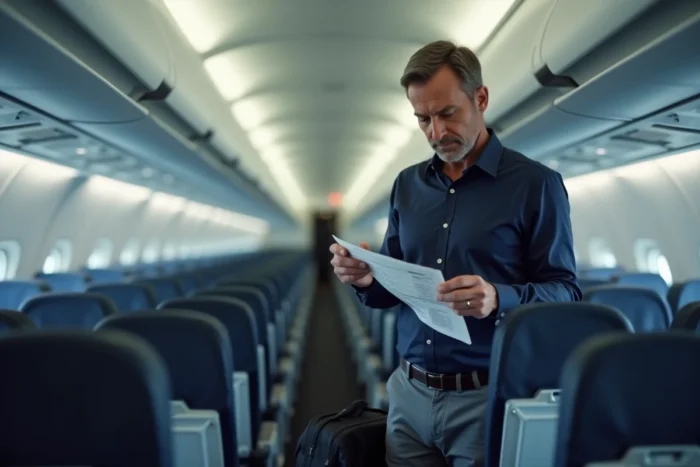
Choosing your seat on the plane: front or back of the cabin
Are you torn between the front rows and the back of the aircraft? The front of the cabin generally offers a slightly more stable flight, with fewer perceived turbulences. Seats located behind the wings, on the other hand, are further away from the engines and the fuselage flex area.
Opt for a seat at the front of the cabin or at the back, avoiding the wing area. Both options have their advantages, but they share one common point: the pressure transition is perceived more gradually than in the mid-section.
Window or aisle side, the choice depends on how you manage your symptoms. An aisle seat allows you to get up easily to walk, drink water, or practice swallowing exercises without disturbing your neighbors. If you are prone to dizziness, being able to get up quickly is a real plus.
Book a seat as soon as you purchase your ticket
On most airlines, seat selection is chargeable in economy class. For passengers with fragile inner ears, this extra cost is a direct investment in flight comfort. Waiting until check-in risks ending up right over the wing.
Earplugs on a plane: models to avoid with hydrops
Foam or wax earplugs, sold everywhere in pharmacies, seem like an obvious solution. They reduce noise, which can be reassuring. However, they pose a specific problem for people suffering from hydrops: standard earplugs block the ear canal without regulating pressure.
The result: instead of helping the Eustachian tube to equalize, they create a closed air space in front of the eardrum. The pressure no longer adjusts at all, and the pain can worsen instead of diminish. ENTs have been warning about this for several years.
So-called “filter” or “pressure-regulating” earplugs work differently. They allow air to pass through in a controlled manner, slowing the pressure change without blocking the canal. Before purchasing, check that the model is designed for air travel and not just for sound comfort.
- Foam or wax earplugs: not recommended, they worsen pressure imbalance in those with hydrops
- Filter earplugs (pressure regulation): suitable for flying, they slow the entry of air without closing the canal
- Custom earplugs from an audiologist: the most precise option, molded to your ear canal
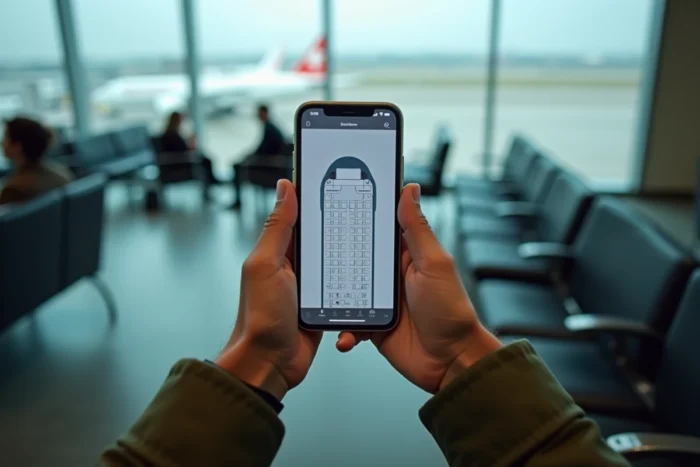
Behaviors during takeoff and landing: what really protects the inner ear
Choosing your seat is not enough. What you do during the critical phases of the flight matters just as much as where you are seated.
Stay awake during descent. When sleeping, you swallow less often, which prevents the Eustachian tube from opening regularly. Cabin crew emphasize this point: many passengers wake up with intense pain simply because they were sleeping during landing.
Hydration also plays a direct role. Drinking regularly before and during the flight helps keep the mucous membranes of the Eustachian tube supple. The cabin air is very dry, which dries out tissues and complicates the natural pressure balancing.
- Swallow or chew gum every two to three minutes during ascent and descent
- Practice the Valsalva maneuver (pinch your nose and gently blow with your mouth closed) if the pressure does not equalize
- Avoid alcohol and caffeinated drinks, which promote dehydration
- Use a saline nasal spray before the flight if your nasal passages are congested
Should you consult an ENT before a long-haul flight?
For patients diagnosed with endolymphatic hydrops or Meniere’s disease, an ENT consultation before a long flight is not unnecessary. The doctor can adjust treatment, prescribe an appropriate decongestant, or contraindicate the flight if a crisis is recent. An ENT opinion before a long-haul flight reduces the risk of in-flight crisis.
The positioning in the plane, the type of earplugs, and the actions during pressure phases form a whole. None of these elements replace the others. A well-chosen seat with poor earplugs, or good behavior in the worst area of the cabin, leaves a gap. It is the combination of the three that effectively protects the inner ear.