
The string trimmer market has shifted in just a few years. Thermal models, long dominant among individuals, are declining in favor of shared battery platforms and local regulatory constraints on noise. Choosing a string trimmer today is less about comparing isolated technical specifications and more about making a decision between a tool ecosystem, a type of power source, and usage conditions dictated by the municipality where one gardens.
Battery ecosystem or standalone tool: the real first criterion for choice
Before looking at power or cutting diameter, the key question is compatibility. Several manufacturers now offer single battery platforms that power string trimmers, lawn mowers, blowers, and sometimes chainsaws. EGO Power+ has taken this logic further in 2025-2026 with multi-tool systems featuring a single motor block and interchangeable accessories.
Buying a string trimmer within an existing ecosystem often costs less than acquiring a model with its own battery. Conversely, if it is the first motorized tool for the garden, the choice of brand commits one for the future.
Field feedback varies on this point: some users find that the battery of a blower poorly powers a demanding string trimmer, while others note no difference. It is essential to check that the voltage and capacity of the block are suitable for each accessory, and the comparisons available on taille-bordure-warrior.com allow for cross-referencing this data by brand.
Thermal, corded, or battery string trimmer: what local regulations change
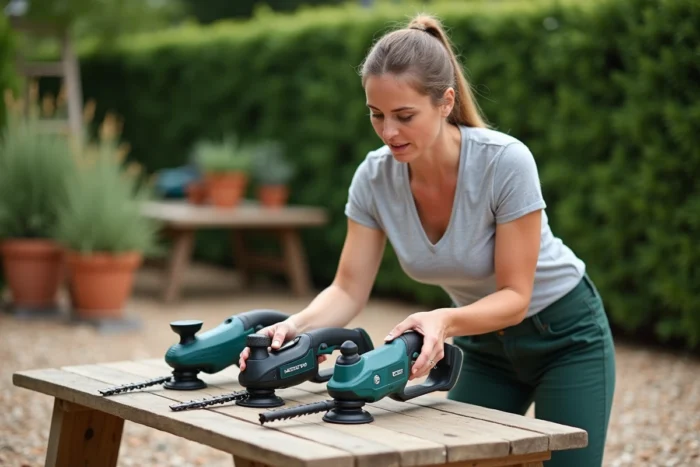
The choice between thermal, corded, and battery is no longer just a matter of budget or area. Many municipalities regulate the time slots for using noisy tools, with fines for non-compliance. A thermal string trimmer, whose noise level significantly exceeds that of an electric model, reduces the allowed gardening window.
Restrictions vary by department, sometimes from one city to another. In some areas, thermal tools are only allowed for a few hours on Saturday mornings. A battery model, being quieter, offers a broader usage window and avoids neighborhood conflicts.
The Bonus Jardiner Durable guides the market
The “Bonus Jardiner Durable” scheme, announced and then renewed in 2026 as part of the France Nature plan, finances part of the purchase price of electric or manual gardening tools. The main condition is not to keep a thermal equivalent. This aid, which can be combined with certain local grants, accelerates the migration to battery models, including for string trimmers.
For an individual still hesitating, the economic calculation increasingly favors electric once the aid is deducted. The available data does not allow for a conclusion on the exact amount of the subsidy, which depends on the place of residence and the type of tool being replaced.
Line, blade, or knife: adapting the cutting head to the terrain
The cutting system is the parameter that comparisons often overlook, while it directly determines the quality of the result and maintenance frequency.
- The rotating nylon line remains the most common. It is suitable for fine grass and finishing along paths. Its rapid wear requires regular replacement or unwinding of the line, which can interrupt work on long border lengths.
- Rotating plastic blades provide a cleaner cut on dense grasses and withstand better contact with hard surfaces (walls, slabs). They break cleanly in the event of a violent shock, protecting the motor.
- Metal knives, found on some powerful models close to brush cutters, tackle brambles and tall grasses. Their use is oversized for simple border maintenance and raises safety concerns in confined spaces.
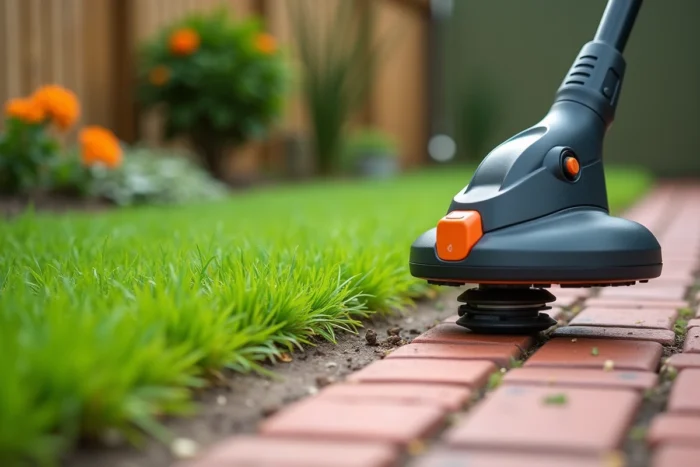
The terrain dictates the choice. A garden with mineral borders (stones, pavers) wears out nylon line quickly. A model with plastic blades will be more durable there. Conversely, on a flowerbed border in loose soil, nylon line is sufficient and costs less to use.
Motor power and battery autonomy: the thresholds that matter
The power displayed in watts (corded) or volts (battery) tells only part of the story. A brushless motor retains its torque longer than a brushed motor and extends battery life. Entry-level models still use brushed motors, resulting in a gradual loss of power over time.
Real autonomy depends on the thickness of the vegetation being cut, not just the advertised capacity. In thick and wet grasses, energy consumption increases significantly. Manufacturers communicate under ideal conditions (dry grass, moderate height), making direct comparisons between brands unreliable without real-world testing.
Husqvarna, EGO, Einhell: what brand choice implies
Husqvarna positions its string trimmers in the semi-professional segment with powerful motors and a network of authorized repairers. EGO Power+ focuses on the shared battery ecosystem and compatibility between tools. Einhell and its Power X-Change range target value for money for medium-sized gardens.
The choice of brand commits to the availability of spare parts (line, blades, batteries) and the sustainability of the platform. An ecosystem abandoned by the manufacturer turns a functional tool into an object without a replacement battery.
Ergonomics and weight: the factor that product sheets minimize
A string trimmer is held at arm’s length, sometimes for an hour. The difference between a well-balanced model with a rotating handle and a heavy model with a fixed shaft is felt after just the second flowerbed border. Several points deserve checking in hand:
- The presence of a harness or shoulder strap, essential beyond a certain weight
- The rotation of the cutting head, which allows switching from border mode to finishing mode without changing position
- The length of the handle, adjustable or not, which must correspond to the user’s height to avoid lower back pain
These details are not always included in online technical sheets. Testing the tool in-store remains the most reliable way to assess real comfort before purchase.
The ideal string trimmer does not exist in absolute terms. It depends on local noise regulations, the battery ecosystem already in place in the garage, the type of vegetation to be cut, and the morphology of the user. Cross-referencing these four parameters before looking at the price avoids most bad purchases.