An inflatable kayak designed for the sea is not chosen like a model for calm waters. Swells, crosswinds, and currents impose constraints on rigidity, course holding, and size that eliminate most entry-level craft. Three technical parameters determine safety and enjoyment while paddling: the floor technology, the fin system, and the regulatory length of the kayak.
Dropstitch floor and inflation pressure: the criterion that product sheets overlook
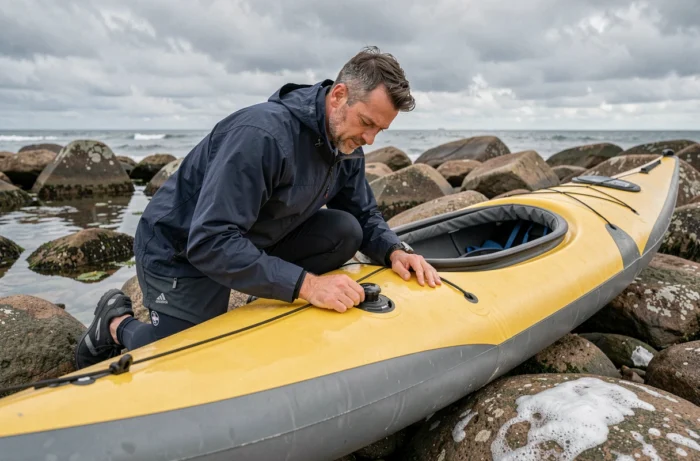
The rigidity of an inflatable sea kayak directly depends on the technology of its floor. A high-pressure dropstitch floor connects the upper and lower walls with thousands of tensioned threads, producing a nearly rigid surface once inflated. The kayak does not deform under the effect of waves and maintains its glide.
A soft single-layer PVC floor, sufficient on a lake, will sag at the first swell. The paddler loses propulsion efficiency, and the kayak becomes laterally unstable. We recommend checking the maximum pressure allowed by the manufacturer: the higher it is, the firmer the floor will be, and the smoother the navigation will be in marine conditions.
To choose an inflatable kayak for the sea, this floor construction criterion should take precedence over price or weight. A soft floor makes any coastal outing difficult as soon as the wind picks up.
Fins and inflatable kayak skegs: keeping course against the sea wind
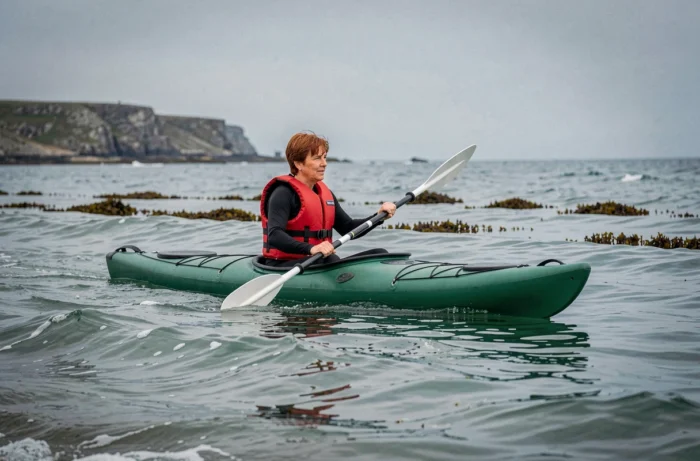
At sea, crosswinds cause an inflatable kayak to drift much faster than a rigid one, due to its surface exposed above the waterline. The skegs attached under the hull compensate for this phenomenon by increasing lateral resistance in the water.
A removable rigid skeg offers the best course holding, but it remains fragile near rocks or in shallow water. Always check its attachment before each launch. Some models offer integrated soft fins, which are less effective for course holding but more tolerant in rocky areas.
Rigid skeg or soft fin: arbitration depending on the spot
On a sandy coastline with little depth, a removable skeg that can be raised remains the best compromise. On rocky coasts, a system of soft fins prevents breakage upon landing. The complete absence of a skeg disqualifies an inflatable for the sea: the paddler exhausts themselves correcting their trajectory and loses all ability to progress against the wind.
Regulatory length and navigation category at sea
The length of the kayak determines its regulatory status, a point that many paddlers discover too late. The ministerial guide for sea kayaking distinguishes two categories:
- Kayaks less than 3.50 m are classified as beach craft and limited to 300 m from the shore.
- Compliant kayaks of at least 3.50 m can navigate up to 2 nautical miles from shelter, during the day, with the required safety equipment.
- A non-compliant kayak used beyond the 300 m band exposes the user to fines and, most importantly, a lack of coverage in case of an incident.
Choosing an inflatable of less than 3.50 m limits you to coastal swimming. For a true maritime outing, whether along a coast or crossing a bay, the minimum length of 3.50 m is not a recommendation but a legal obligation.
Stability of the inflatable kayak in marine conditions: primary, secondary, directional
Consumer articles talk about “stability” as a single criterion. In maritime navigation, three types of stability come into play and do not compensate for each other.
Primary stability corresponds to the balance felt on flat water: a wide, flat-bottomed kayak increases it. Secondary stability comes into play when the kayak tilts due to a wave or lateral pressure. A model with a rounded hull offers better secondary stability, making it safer in swells even if it seems less stable initially.
Directional stability depends on the length, shape of the hull, and skegs. A short and wide kayak pivots easily but drifts at the slightest breeze. A long and narrow model holds course better, at the cost of reduced primary stability.
The right compromise for the coastline
For regular coastal use, prioritize an inflatable long enough (beyond the regulatory threshold of 3.50 m), with moderate width and a dropstitch floor. This size offers an acceptable balance between secondary stability in swells and course holding against the wind.
Wind and returning to shore: the trap that equipment alone cannot solve
A perfectly suited kayak is not enough to guarantee a safe outing. A favorable wind on the way out can become a headwind on the return, as fatigue accumulates and conditions change. The opposition between wind and tidal current generates steeper and more irregular waves, significantly more demanding than mere swells.
Before each outing, identify intermediate exit points along your route. Assess your actual ability to return, not just to set off. The ease of landing at the return spot (sandy beach, ramp, rocks) should be checked in advance, especially with an inflatable whose hull does not handle contact with abrasive surfaces well.
- Check wind and tide forecasts for the entire expected duration, not just for the departure time.
- Plan a route with at least one accessible fallback point in case of rapid deterioration.
- Bring the safety equipment corresponding to your navigation category (life jacket, means of location, communication device).
The choice of inflatable kayak sets a technical framework. The preparation for each outing remains the determining factor between enjoyable navigation and a risky situation along the coastline.