
Buying a non-buildable plot of land to establish an orchard, a leisure area, or simply to preserve family heritage requires a mandatory visit to the notary. The transaction amount is often modest, sometimes just a few thousand euros, but the additional costs weigh proportionally heavier than in a classic real estate purchase. Understanding their composition helps avoid unpleasant surprises at the time of signing the authentic deed.
Increase in transfer taxes since 2025: what changes for non-buildable land
A non-buildable plot sold between individuals falls under the old tax regime. The transfer taxes (DMTO) constitute the largest part of the notary fees. Since the finance law for 2025, departments can raise their share of these taxes from 4.50% to 5.00% for deeds executed between April 2025 and March 2028.
In practice, the overall registration tax rate reaches about 6.32% in departments that have voted for this increase, which is a majority of them. For a non-buildable plot, this increase of about 0.5 points is felt even more since the purchase price remains low: on a plot costing a few thousand euros, each half-point represents a significant relative additional cost.
However, buyers who plan to use the land for a future primary residence have a lever. The 2025 reform provides that first-time buyers purchasing their primary residence are exempt from the departmental increase, even in departments that have opted for the 5% rate.
Checking eligibility with the notary before signing can therefore reduce the bill. Those who detail the notary fees for non-buildable land also remind that this distinction between first-time buyers and wealth investors significantly alters the final calculation.
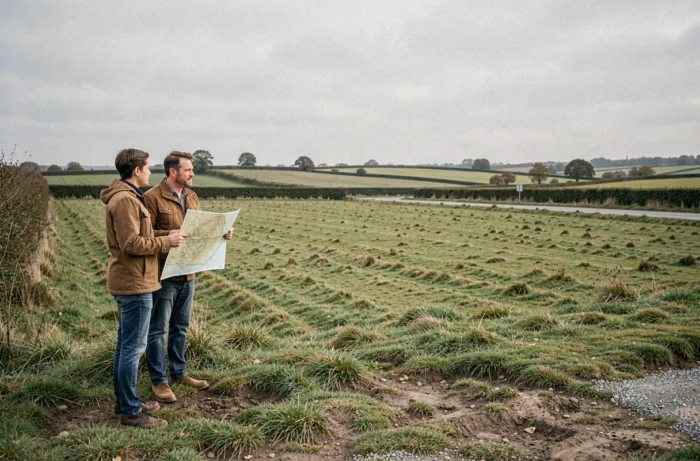
Notary fees on low-priced land: the trap of the decreasing scale
The notary fees are regulated by a national decreasing scale. The higher the price of the property, the lower the rate applied per bracket. For a low-priced non-buildable plot, one finds oneself in the higher brackets of the scale.
- From 0 to 6,500 euros: the fee rate applies at the highest level of the scale, which weighs heavily in proportion to the total price.
- From 6,500 to 17,000 euros: the rate decreases but remains significantly higher than that of the upper brackets.
- Above 60,000 euros: the rate drops to the lowest level, but few non-buildable plots reach this amount.
On a plot priced at 5,000 euros, the fees alone can represent several hundred euros. Add the transfer taxes and disbursements, and the total proportion of fees relative to the purchase price easily climbs above 15%, where a classic real estate property hovers around 7 to 8%. This imbalance often surprises buyers who expect marginal fees.
Disbursements and additional costs not to be overlooked
The disbursements cover the costs incurred by the notary to obtain the necessary documents for the sale: cadastral extracts, mortgage status, urban planning certificate. Their amount is relatively fixed, regardless of the value of the land. In a low-priced transaction, they further increase the proportional bill.
The real estate security contribution, paid to the land publicity service, is also added. It is calculated on the sale price with a minimum that cannot be reduced. For a low-value non-buildable plot, this fixed minimum makes notary fees structurally high as a percentage.
Non-buildable land and VAT: when the seller is a professional
The majority of transactions on non-buildable plots occur between individuals, applying the classic transfer taxes. The situation changes when the seller is a VAT-registered professional.
When a property dealer or developer resells a non-buildable plot, the sale may be subject to VAT on the total price. The transfer taxes then shift to the reduced rate, which significantly lightens the overall acquisition fee bill.
The regime depends on the exact status of the seller and the nature of the operation. Asking the notary about this as soon as the promise of sale is made helps clarify this point.
Conversely, an individual selling a plot acquired long ago does not charge any VAT. The buyer then bears the full registration taxes at the full rate, increased in the relevant departments since 2025.
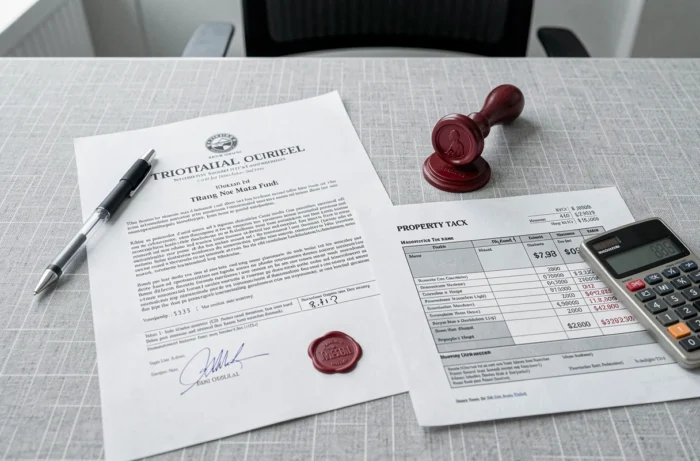
Preliminary checks by the notary: what the service really covers
The role of the notary is often reduced to a stamp on a sales deed. However, for a non-buildable plot, their intervention covers specific checks that justify part of the disbursements.
- Consultation of the Local Urban Planning Plan (PLU) to confirm the classification of the land as natural, agricultural, or other non-buildable zone.
- Verification of any easements (passage, networks, preemption rights of SAFER for agricultural land).
- Obtaining the urban planning certificate, which specifies the applicable rules for the plot and may reveal constraints related to natural risks.
- Checking the property ownership history for the last thirty years to secure the chain of transmission.
These procedures take time and generate fixed costs. For a non-buildable plot, the cost of these checks remains the same as for a building plot, while the sale price is generally much lower. This is the main reason why the proportion of fees seems disproportionate.
Negotiating fees: a limited margin
The notary can grant a discount on their fees, within the limits set by regulations. This discount only applies to the portion exceeding 150,000 euros, making it inapplicable for almost all non-buildable plots. The only variable for adjustment remains the negotiation of any additional advisory fees, if the notary charges for services distinct from the sale deed itself.
The heaviest item, the transfer taxes, is non-negotiable. It depends on the department and the buyer’s status. Before signing, it is advisable to ask the notary for a detailed line-by-line simulation, rather than a global percentage that obscures the reality of each component.