
A text message received after midnight activates a disproportionate interpretive circuit compared to the amount of information it contains. Three words on a screen, and the recipient reconstructs a complete scenario. To analyze this phenomenon, we start from a mechanism that is rarely addressed in popular articles: nocturnal digital disinhibition.
Nocturnal disinhibition and SMS: the cognitive mechanism behind the late message
Cognitive fatigue at the end of the day reduces the activity of the prefrontal cortex, the area of the brain responsible for impulse control and self-censorship. This phenomenon, described by several psychologists under the term nocturnal digital disinhibition, explains why a person sends messages at night that they would not dare to formulate during the day.
The darkness and solitude amplify this effect. The feeling of being less exposed to judgment acts as an inverted filter: the person perceives themselves as protected by the night, which lowers their social barriers. The SMS then becomes a perceived low-cost channel for emotional expression.
This mechanism is not gendered. It affects both men and women. When we observe it in a girl sending a message late at night, we simply see the manifestation of a specific neuropsychological state, not necessarily a signal of romantic interest. Understanding the meaning of a late-night SMS first requires distinguishing what pertains to brain chemistry and what pertains to relational intention.
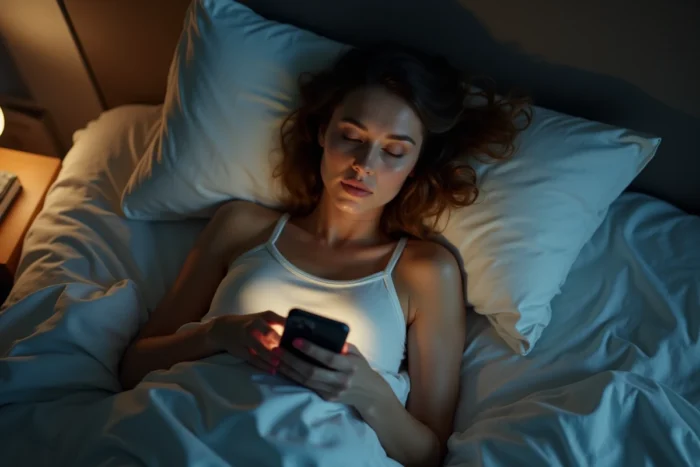
Late-night SMS from a girl: signals that differentiate real interest from passing impulse
The content of the message matters more than the time it was sent. We recommend focusing on three concrete indicators rather than overanalyzing the timing.
- The substance of the message: an open question about your day, your plans, or a personal topic indicates an investment in the conversation. A simple “are you sleeping?” or an isolated emoji is more often a sign of impulse or nighttime boredom.
- The reciprocity in the exchange: if she follows up, asks questions in return, and elaborates on her responses, the level of interest exceeds the procrastination reflex of going to bed. An exchange that fizzles out after two messages rarely indicates a strong intention.
- The regularity of the behavior: an isolated late-night message means nothing reliable. A recurring pattern of late-night texts is a much stronger indicator than a single episode, regardless of the perceived emotional intensity.
We observe that many recipients focus on the moment of receipt rather than the content. This framing error generates unnecessary anxiety and incorrect interpretations.
The trap of overinterpreting timing
A message sent at 11:30 PM does not carry the same weight as a message sent at 3 AM, but this distinction does not change the nature of the intention. The time of sending reflects a state of availability, not a degree of feeling. An insomniac or someone working irregular hours texts late without any particular connotation.
Chronotypes also play an underestimated role. Night owl profiles naturally concentrate their social activity in the evening. This personality trait, linked to the individual circadian rhythm, has no connection to relational intensity.
Revenge bedtime procrastination: when the late-night SMS has nothing to do with you
Revenge bedtime procrastination refers to the act of deliberately delaying bedtime to reclaim personal time after a day of obligations. This phenomenon, increasingly documented, particularly affects those whose day is saturated with work or family responsibilities.
In this context, the late SMS functions as a micro-activity of reclaiming free time. The person is not writing to you because they have been thinking about you for hours. They are writing to you because it is the first moment of the day when they have their own time, and you are among the people they choose to spend it with.
This is neither a negative signal nor a positive signal in itself. Distinguishing it from romantic interest requires cross-referencing with other indicators: message content, regularity, reciprocity.
How to respond to a late-night SMS without jeopardizing your chances
The response to a late message conditions the continuation of the exchange more than the initial message itself. A few technical principles deserve to be established.
- Respond within a natural timeframe: if you are awake, respond. Waiting artificially to appear detached is counterproductive and noticeable. Nocturnal spontaneity calls for a spontaneous response in return.
- Calibrate the length to that of the received message: a lengthy reply to three words creates an immediate imbalance. Align your investment with that of the sender.
- Avoid meta-conversation about the time: “aren’t you sleeping?” or “it’s late to be texting” breaks the intimate frame that night naturally establishes. Enter into the subject of the message without commenting on the temporal context.
- Do not turn a light exchange into a declaration: nocturnal disinhibition works both ways. What you write at 2 AM may seem excessive the next morning.
Silence as a valid response
If you are sleeping, do not respond. A message read and replied to the next morning with quality content is better than a drowsy response at 3 AM. Most people who send texts late at night do not expect an instant reply.

The night changes the way we communicate, not necessarily what we feel. A late-night SMS from a girl can indicate interest, boredom, a need for social connection, or simply that it is her first moment of calm. Reading the content and observing the regularity remains the only reliable method to distinguish a nocturnal habit from a real relational signal.