When looking for a job in Paris, the instinct is often to apply indiscriminately without considering where the position is located. After several interviews, one ends up discovering that job offers are not evenly distributed across the districts. Some neighborhoods concentrate a much higher density of listings than others, and this geography influences both commute times and the type of contract offered.
Job offers in Paris: the logic of transport hubs, not just office towers
Competitors on this topic almost exclusively discuss historic business districts. We overlook an observable phenomenon on the job offer maps of France Travail for several years: job listings are densifying around major multimodal transport hubs.
Gare du Nord, Gare de l’Est, Montparnasse, Saint-Lazare, as well as metro-RER interchange hubs like Nation, Place d’Italie, or Bibliothèque François-Mitterrand attract employers from various profiles. There, one finds classic tertiary positions, but also offers in health, personal services, and urban logistics.
For a candidate, this changes the game. Rather than targeting a district based on reputation, it is beneficial to identify job offers on Mag Paris by cross-referencing industry sector and transport accessibility. A position located just steps from an RER hub in the 13th arrondissement may be more accessible than an office in the Central Business District for someone living in the southern suburbs.
Business districts of Paris: where white-collar jobs are concentrated
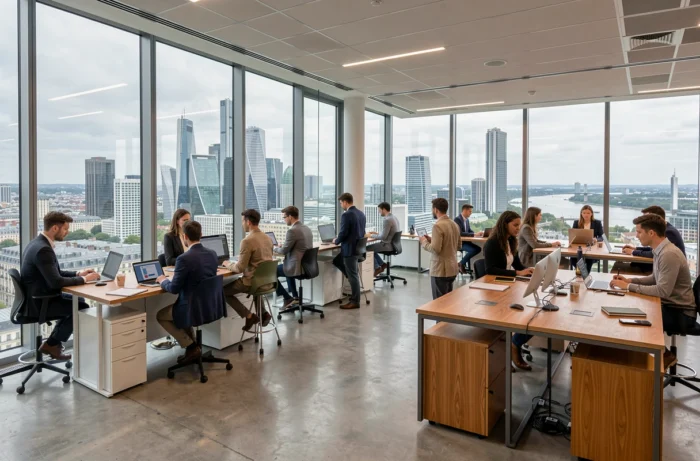
The golden triangle between the 8th and 9th arrondissements remains the historic heart of the Parisian tertiary job market. The Opéra, Bourse, and Étoile sectors account for a massive share of offers in finance, consulting, and insurance. The headquarters of major corporations have been established here for decades, and the network of service companies that revolves around it generates a constant flow of listings.
The 1st and 2nd arrondissements complement this hub with a more tech and startup flavor, particularly around Sentier. Here, one finds offers in web development, digital marketing, and product management that did not exist in this form ten years ago.
The CBD and its limits for candidates
Working in these districts comes with an indirect cost that is rarely mentioned: lunch expenses, the price of a coffee between meetings, and especially rent if one wishes to live nearby. The 8th arrondissement boasts some of the highest square meter prices in the capital. There is a lot of recruitment here, but entry-level candidates often have to accept a long commute from a more affordable arrondissement or city.
Employment in East Paris: the rise of the 10th, 19th, and 20th arrondissements
The popular neighborhoods of East Paris carry an increasing share of job offers, particularly in proximity jobs. Home care, neighborhood restaurants, cleaning, small logistics: these listings are multiplying on France Travail and specialized agencies in the 10th, 19th, and 20th.
This phenomenon can be explained by the population density of these arrondissements and the aging of some of their residents, which generates needs for personal services. For a candidate without specific qualifications or in retraining, these neighborhoods offer more direct access to employment than the tertiary zones in the center-west.
- The 10th arrondissement, around the Gare du Nord and Gare de l’Est, combines tertiary offers (agencies, coworking) and positions in the hospitality sector related to passenger traffic.
- The 19th arrondissement, structured around the Villette basin, is seeing the development of positions in events, culture, and services for businesses located in former rehabilitated industrial premises.
- The 20th arrondissement remains a reservoir for proximity jobs: food retail, crafts, elderly assistance.
Left Bank and 13th arrondissement: an underestimated employment hub
Less is said about the left bank when discussing employment in Paris, and this is a mistake. The 13th arrondissement concentrates a growing number of offers thanks to the development of the Paris Rive Gauche neighborhood around the Bibliothèque François-Mitterrand. Universities, corporate headquarters, incubators: the sector has undergone a significant transformation.
The 15th arrondissement, the most populated in Paris, also generates a significant volume of offers, particularly in health (proximity to the European Georges-Pompidou Hospital and Necker) and business services. Feedback on this point varies according to sources, but the trend observed on job boards shows a steady increase.
The 5th and 6th: a niche market
These historic arrondissements on the left bank are more focused on higher education, publishing, and research. The gross volume of offers is lower, but the positions offered are often qualified and stable. A candidate in these fields would do well to specifically monitor these areas rather than casting a wide net across all of Paris.
Choosing your job search neighborhood in Paris: concrete criteria
Rather than ranking the arrondissements from most to least job-providing, it is beneficial to cross-reference three parameters:
- The targeted industry sector, as each neighborhood has a more or less marked specialization (finance in the 8th, tech in the 2nd, personal services in the East).
- The actual commute time from home, taking into account the saturated metro and RER lines during peak hours.
- The cost of living on-site (lunch, local transport), which can significantly reduce an attractive gross salary on paper.
The distribution of job offers in Paris is not fixed. Urban projects, the arrival of new transport lines, and sectoral changes regularly reshuffle the cards. Monitoring transforming neighborhoods, such as the northern part of the 17th or the Bercy-Charenton sector, allows one to anticipate the next recruitment areas before they become saturated with candidates.