The autumn-winter 2026-2027 season marks a regulatory as well as stylistic turning point. The ban on destroying unsold textiles, effective since July 19, 2026, for large companies in the European Union, reshuffles the production cards and directs collections towards tighter volumes and materials with an extended lifecycle.
European Regulation on Unsold Textiles: What Changes for Autumn-Winter Collections
The delegated regulation (EU) 2026/296 prohibits large companies from destroying unsold clothing, accessories, and shoes, except for regulated exceptions. Companies must now report annually on the products eliminated, the reasons, and their mode of treatment.
At the same time, the European directive 2025/1892 on extended producer responsibility requires member states to establish systems for collection, sorting, reuse, and recycling. Financial contributions from brands will be adjusted according to eco-design criteria, including the durability and recyclability of the fibers used.
For designers and collection directors, the consequence is direct: produce fewer references, focus on pieces whose end-of-life treatment cost remains low. Several houses are already tightening their ranges, with shorter drops and restocks calibrated to actual demand.
Brands following this logic are also anticipating the arrival of the digital product passport, which will require complete traceability of materials, from fiber to finished garment.
These regulatory constraints are concretely reflected in the style offered this season, refocusing the news on Have a Fashion Break around sustainable pieces rather than disposable micro-trends.

Materials and Finishes for Autumn-Winter 2026: Recycled Wool, Vegetable-Tanned Leather, and Heavy Denim
The choice of materials reflects this regulatory shift. Recycled wool is gaining ground over synthetic blends because it ticks both the durability and recyclability boxes, two criteria that will modulate brands’ contributions under the extended responsibility regime.
Heavy denim is making a strong comeback on the runways and in production. Dense, non-stretch fabrics better withstand cycles of reuse and resale. Raw or slightly faded finishes dominate, in contrast to the heavy chemical treatments that new standards on chemicals and wastewater make more costly.
Vegetable-Tanned Leather and Alternatives
Vegetable tanning is progressing in leather goods and footwear collections. This process, less dependent on chrome, simplifies compliance with European requirements on PFAS and industrial discharges. We recommend systematically checking traceability certifications, as the digital product passport will make this information accessible to the end consumer.
- Certified GRS recycled wool for structured coats and sweaters, with a sufficiently dense weight to last several seasons
- Raw denim in organic or regenerative cotton, favored for straight cuts and barrel jeans that remain a key silhouette
- Vegetable-tanned leather on investment pieces (jackets, ankle boots, bags), where natural patina becomes a resale argument
Key Colors and Prints for the Autumn-Winter Season
The autumn palette tightens around deep shades and a few saturated accents. Bordeaux, chocolate brown, and forest green form the chromatic base of most collections. These colors have a technical advantage often overlooked: dark dyes on natural fibers resist better to repeated washes, aligning with the sustainability logic imposed by the regulatory framework.
Butter yellow, already seen in spring-summer 2026, persists in a more muted version for winter, particularly on knits and felted wool accessories.
Prints: The Return of Tartan and the Rise of Color Blocking
Tartan is making a generous comeback, featured on oversized coats and mid-length skirts. Wide checks, treated tone-on-tone, replace the contrasting patterns of previous seasons.
Color blocking structures looks by playing with blocks of two or three colors maximum per outfit. This graphic approach works particularly well on the clean silhouettes that dominate this season.
Silhouettes and Key Pieces: Wide Pants, Short Jackets, and Mastered Layering
The wide cut in pants is here to stay. The barrel jean, already identified as a trend in spring, is available in an autumn version with heavier fabrics and raw shades.
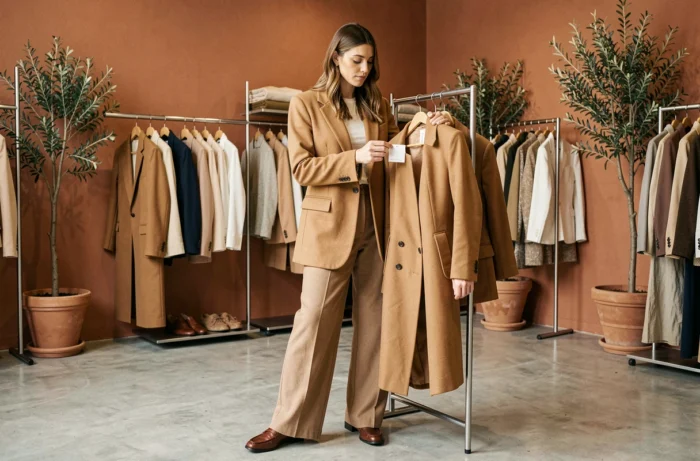
The structured short jacket becomes the pivot piece of the autumn wardrobe. Worn over a fine knit and high-waisted pants, it creates a sharp silhouette that works well in both professional contexts and daily outfits. Versions in boiled wool or recycled tweed fit into the logic of high-value reuse pieces.
Technical Layering
Layering is not just about piling on layers. This season, we observe precise work on lengths and textures:
- A fine ribbed turtleneck under an open shirt, itself covered by a thick knit sleeveless vest
- A short trench worn over an oversized sweater, with fluid pants that break the rigidity of the top
- Voluminous scarves in recycled wool used as a structuring piece, not just as an accessory
Each layer must justify its presence through a thermal or visual function. Decorative accumulation is losing ground to a more technical approach to layering.
The autumn-winter 2026-2027 fashion trends can be read through this dual prism: a European regulatory framework pushing brands towards tighter and traceable collections, and stylistic choices that value the longevity of pieces. Wide pants, short jackets, dense natural materials, and a dark palette form a coherent wardrobe designed to last beyond a season.