
The Swiss technical market is experiencing tensions concentrated in a few specific professions. According to the Adecco/Stellenmarkt-Monitor shortage index, four professional categories out of thirty-two still showed a significant imbalance between supply and demand in 2025, including engineers and technical managers. Recruiting in this sector therefore requires a tailored approach to very localized tensions, not a volume strategy.
Shift in technical shortage: what AI changes for recruitment in Switzerland
The spread of artificial intelligence is reshaping the landscape of in-demand professions. The 2019-2025 analyses by JobCloud (jobs.ch, jobup.ch, JobScout24) show that highly automatable IT professions are becoming easier to fill. The opposite trend is occurring for less automatable technical roles: industrial maintenance, construction, production technology.
This shift has a direct consequence on recruitment strategy. Searching for a generalist back-end developer requires fewer resources than it did three years ago. In contrast, a CNC maintenance technician or an electrical engineer remains a rare profile, with longer recruitment timelines.
For companies in the technical sector, the priority is to identify which category each open position falls into: automatable (decreasing tension) or less automatable (increasing tension). This classification determines the sourcing budget, the distribution channel, and the level of compensation to offer. Specialized players in technical placement support this segmentation, as seen on https://techna-personal.ch/, which focuses on industrial and engineering sectors.
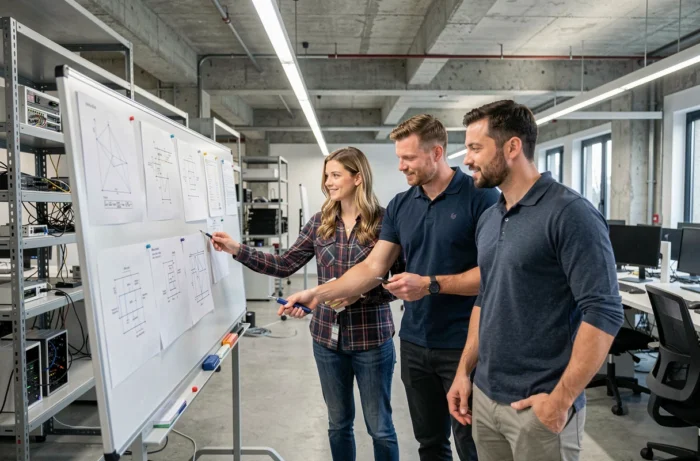
Technical skills and cultural fit: the dual filter of Swiss recruiters
Swiss recruiters apply a dual filter that candidates often underestimate. The first is technical and verifiable: mastery of software, knowledge of a standard, ability to solve a problem in context. The second is cultural and more subtle.
Methodological rigor is as important as raw competence. An engineer who structures their response, documents their reasoning, and anticipates objections meets the expected standard in Swiss companies, whether in the French-speaking or German-speaking regions.
Technical assessment: what distinguishes a Swiss process
The technical interview in Switzerland goes beyond a simple knowledge test. Recruiters observe how the candidate reasons under pressure, their management of uncertainty when they do not know the answer, and their ability to verbalize a decision-making process.
A practical exercise (case study, situational analysis on an industrial diagram, fault analysis) often replaces the theoretical questionnaire. Transparency about one’s technical limitations is better perceived than an approximate answer: admitting that one does not master a specific tool while showing how they would learn it constitutes a positive signal.
Cultural fit: the decisive factor when skills are equal
With comparable qualifications, the majority of Swiss recruiters prefer a profile perceived as culturally compatible. This compatibility is based on concrete elements:
- Punctuality and preparation before the interview, seen as a marker of professionalism, not just a courtesy
- The ability to work in a multilingual environment, even without perfect mastery of German or Italian, by showing a willingness to adapt
- Respect for the decision-making hierarchy, more pronounced than in France, with validation circuits often taking longer
Technical sourcing channels in Switzerland: where to focus efforts
The Swiss job market operates partly through a hidden market where positions are never published. For technical profiles, this reality is amplified by the specialization of sought-after skills: a maintenance manager or a process engineer is rarely recruited through a generalist ad.
The most effective channels for technical recruitment follow a logic of sector proximity:
- Specialized firms in engineering and industry, which have pools of pre-qualified candidates with niche skills
- Direct professional networking, through engineering associations (SIA, ASETA) or industrial fairs, which remains the primary channel for technical management positions
- Swiss job platforms (jobs.ch, jobup.ch), relevant for high-volume positions but less effective for rare profiles
- Internal referrals, particularly common in industrial SMEs where a recommendation from a current employee accelerates the process

Work permits and cross-border technical recruitment
Recruiting a technical profile from outside Switzerland requires mastering the framework of work permits. For EU/EFTA nationals, the B or G (cross-border) permit remains accessible, but Swiss companies overwhelmingly prefer local profiles with equal qualifications. This local preference rate increases further in German-speaking Switzerland.
For non-European candidates, the administrative complexity poses a real barrier. The majority of companies surveyed in the Von Rundstedt study mention difficulties in recruiting outside Europe. A technical recruiter considering this option must anticipate delays of several months and demonstrate that no local or European candidate fits the position.
This constraint reinforces the importance of proactive sourcing. Waiting for a position to become vacant to start the search exposes one to timelines incompatible with operational needs, especially for engineering profiles where the shortage remains concentrated.
Technical recruitment in Switzerland is based on an operational paradox: the overall shortage is decreasing, but the most difficult positions to fill are becoming even more so. Targeting the right channel, calibrating the evaluation on method as well as competence, and anticipating administrative constraints for international profiles remain the foundation of an effective technical recruitment process in 2025.