
The message “engine failure risk” that appears on the dashboard of a Clio 4 diesel does not always indicate a serious mechanical failure. Several owners report this alert on vehicles that have been serviced, sometimes without any fault code recorded in the diagnostic tool. The question then arises: how to distinguish a critical alert from a simple electronic malfunction, and what actions to take depending on the case?
Common causes of the engine failure alert on Clio 4 1.5 dCi
| Probable origin | Associated symptoms | Severity |
|---|---|---|
| Faulty crankshaft or camshaft sensor | Difficult starting, stalling, then message on the dashboard | Low to moderate (sensor needs replacing) |
| Fuel rail pressure issue | Loss of power, smoke, entering limp mode | Moderate to high |
| Worn or misaligned timing belt | Knocking noise, abnormal vibrations at idle | High (risk of actual failure) |
| Cooling circuit anomaly | Temperature rise, temperature warning light on | High if prolonged overheating |
| ECU bug or electrical harness issue | Intermittent alert, disappears after battery disconnection | Low (no mechanical fault) |
This table summarizes the most documented cases on specialized forums. The common point: the alert does not distinguish between an electronic bug and a mechanical failure. The driver’s reaction must therefore follow a precise protocol, regardless of the assumed scenario.
Several Clio 4 diesel owners have noticed that the engine failure risk on the Clio 4 diesel sometimes appears intermittently, without leaving a trace in the ECU’s memory. This phenomenon complicates diagnosis in the workshop.
Stop protocol and diagnosis after the engine failure alert
Renault recommends a structured reaction when the message appears. Turning off the engine as soon as possible remains the first instruction, even if the vehicle seems to be running normally. Continuing to drive with this alert active can turn a minor issue into a real engine failure.
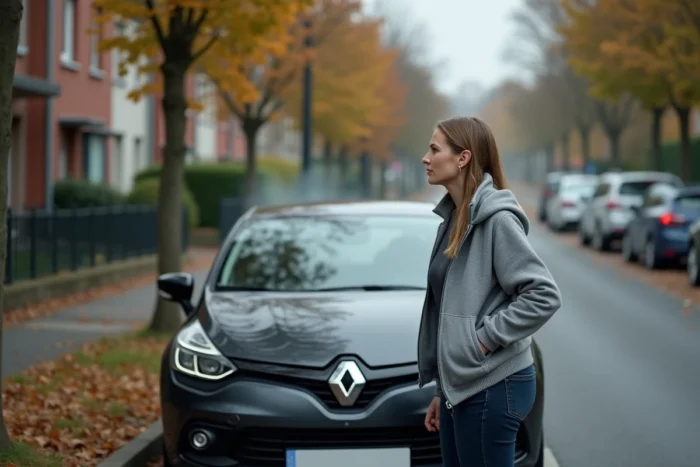
Once the vehicle is immobilized, the verification sequence follows a logical order:
- Visually check the engine oil level and coolant level. A deficiency in either immediately points to a serious mechanical cause.
- Attempt a restart after a few minutes of waiting. If the message disappears and the engine runs without suspicious noise, a sensor fault or ECU bug is likely.
- If the message persists or if the engine refuses to start, have the vehicle towed. Do not attempt repeated starting, as this may worsen a timing issue.
- Have the fault codes read with a compatible Renault diagnostic tool (clip or equivalent). Codes P0335 (crankshaft sensor) and P0340 (camshaft sensor) are among the most common for this engine.
Disconnecting the battery for a few minutes can erase the alert, as reported by several users. However, this action does not resolve the underlying cause. It masks the problem and delays diagnosis.
Aging Clio 4 diesel fleet and preventive maintenance
The Clio 4 diesel fleet is aging. According to data from SDES (Service of Data and Statistical Studies), the circulation of diesel cars has been declining in France for several years. These vehicles are driven less than before, but their age is increasing.
This combination of “fewer kilometers driven, but older vehicle” creates a trap. The owner looks at the odometer, sees a moderate mileage, and postpones maintenance. The 1.5 dCi engine, although reputed to be robust, is not immune to the constraints of time.
Timing belt on the 1.5 dCi
The timing belt also degrades due to calendar aging, not just mileage. A vehicle that has exceeded the recommended replacement age, even with mileage below the threshold, presents a real risk of breakage. On the 1.5 dCi, a timing belt breakage almost systematically causes a collision between pistons and valves.
The cooling circuit deserves the same vigilance. Hoses and the thermostat age, and head gaskets can weaken. A brief but repeated overheating, sometimes without the warning light coming on clearly, is enough to deform the cylinder head over the long term.
Engine oil and injector fouling
Prolonged urban use, typical of aging Clio 4 diesels, promotes fouling. Short trips prevent the oil from reaching its optimal temperature and the particulate filter from regenerating properly. An incomplete regeneration cycle of the DPF can trigger the engine failure alert on certain versions of the ECU.
Engine oil plays a direct role in the longevity of the turbo and piston rings. For a diesel that mainly makes trips of a few kilometers, the oil change interval should be shortened compared to standard recommendations.
Repair costs and economic considerations for a Clio 4 diesel
The appearance of the engine failure alert raises a financial question as much as a technical one. The residual value of a Clio 4 diesel over eight years old remains low. Faced with a quote for timing belt replacement with water pump, or worse, cylinder head replacement, the decision becomes delicate.
Some guidelines to help with the decision:
- Replacing a crankshaft or camshaft sensor is a modest intervention, often achievable in less than an hour of labor.
- Replacing the timing belt with a complete kit (tensioner pulley, water pump) is a more significant but preventive investment.
- A cracked cylinder head or a damaged engine block often exceeds the market value of the vehicle. In this case, replacing it with a used engine or selling it as-is become realistic options.
A precise diagnosis before any financial commitment remains the only rational approach. An isolated fault code on a sensor does not justify panic. Conversely, a loss of coolant combined with the engine failure alert points to a scenario that is much more costly.
Careful reading of the fault codes, cross-referenced with the vehicle’s maintenance history, provides the best decision-making basis. On a well-maintained 1.5 dCi engine, the alert is often of electronic origin. On a vehicle whose timing belt or cooling circuit has never been checked, the message deserves to be taken literally.