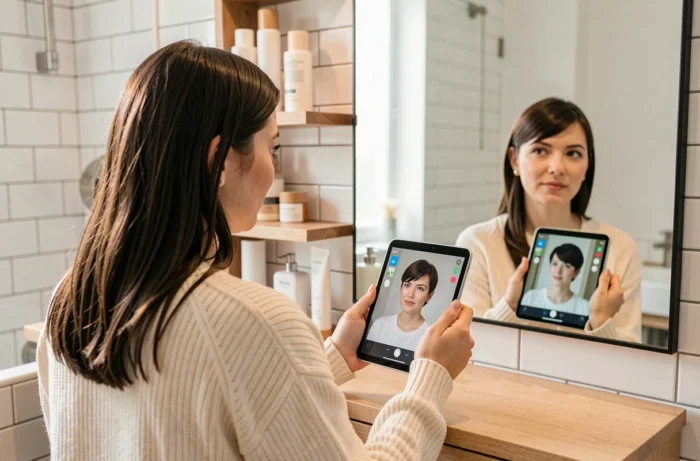
Online hair cutting simulators have been multiplying for several years, driven by advances in generative AI. These tools promise to visualize a haircut or color on one’s own face before heading to the salon. Their adoption now goes beyond mere entertainment: some hair salons are integrating these simulators directly into their client consultation process.
Haircut Tester and AI Transparency Requirements in Europe
A point that most hair simulation platforms do not yet clearly address concerns the regulatory framework. The European AI Regulation (EU AI Act) imposes transparency obligations for all systems that generate images that could be confused with real content, effective from August 2, 2026.
Haircut simulator providers must label the images produced with machine-readable metadata and clearly indicate that the result is generated by artificial intelligence. This requirement aims to prevent photorealistic renderings from being mistaken for real photographs.
For users, this means that a compliant haircut tester must display a visible notice on each simulation. Platforms that do not comply with this requirement face sanctions, and feedback from the field varies on the actual degree of enforcement of these rules by market players.
In-Salon Hair Simulation: A Dialogue Tool Between Client and Stylist
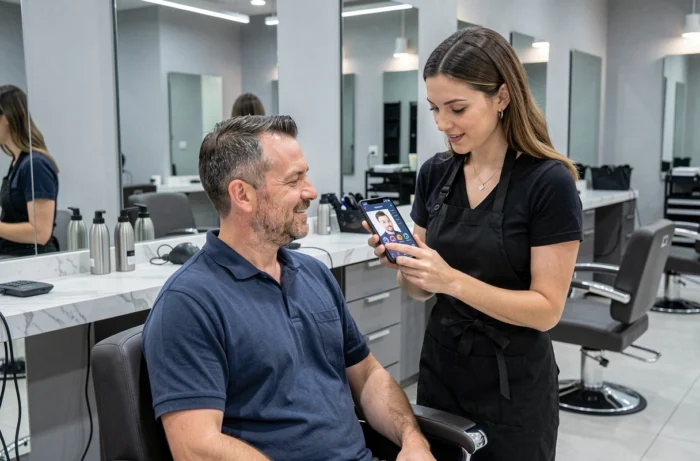
The most interesting use of the haircut tester does not necessarily take place on your smartphone. Since 2026, hair salons have been using virtual try-ons directly on tablets at the chair or in their booking application. The goal is concrete: to alleviate the fear of regret before confirming a haircut.
This device changes the dynamics of the consultation. Instead of arriving with a vague description or an unsuitable celebrity photo, the client sees the simulated result on their own face, in the salon’s lighting. To delve deeper into this type of approach, Blog Beauté’s hair tips detail how to make the most of a virtual try-on.
The main benefit reported by professionals is the reduction of vague requests like “something different but not too much.” The simulation serves as a common visual aid that aligns the client’s expectations with the stylist’s interpretation. The available data does not allow for precise quantification of the impact on satisfaction, but initial feedback indicates a smoother consultation.
Technical Limitations of Online Haircut Simulators
The promise of a realistic rendering deserves to be nuanced. Several factors influence the reliability of the result displayed by a hair simulator.
- The quality of the input photo plays a decisive role: a poorly lit or angled selfie produces an unusable simulation, regardless of the tool used
- Very curly, frizzy, or very fine hair textures are still poorly managed by most generative models, which have been trained on under-diversified datasets
- The rendering does not take into account the actual volume or thickness of the hair, which can create a significant gap between the simulation and the result after cutting
- The color displayed on the screen depends on your screen calibration: an ash blonde on one smartphone may appear golden on another
These limitations explain why a professional stylist remains necessary to validate the feasibility of a haircut. The simulator guides, it does not decide.
Free vs. Paid Haircut Tester: What Really Changes
Most platforms offer limited free access and paid plans. The difference does not always lie in the quality of the rendering.
Free versions generally allow testing a few predefined styles on a photo. Paid versions unlock customization: choice of length, fringe adjustment, color simulation, multi-angle views. Some services add an AI hair diagnosis (porosity, density, hydration), but the reliability of these automated analyses remains debated.
A point to check before signing up: the photo retention policy. Your face constitutes a biometric data. Simulators compliant with GDPR must specify the storage duration and offer image deletion upon request. In contrast, third-party mobile applications, especially those distributed outside the main stores, do not always provide these guarantees.
Criteria for Choosing a Reliable Simulator
- Check for the presence of a “image generated by AI” notice on the results, a sign of regulatory compliance
- Prefer tools that work without downloading, directly in the browser, to limit access to phone data
- Test with a well-lit photo, clear face, neutral background: the quality of the input determines the output quality

Face Shape and Hair Simulation: A Parameter Often Oversold
Several simulators highlight face shape analysis as a main selling point. The idea is appealing: AI detects whether your face is oval, round, square, or heart-shaped, then recommends suitable cuts.
In practice, this analysis remains simplistic. A stylist evaluates the face shape but also the hair growth pattern, jawline, forehead-chin proportion, and hair texture. The algorithm captures only a fraction of these criteria. Using the automatic recommendation as a starting point is reasonable, following it blindly is much less so.
The haircut tester works better as an exploration tool than as a prescriber. It allows for quickly eliminating styles that clearly do not fit and preparing a selection to discuss with one’s stylist. This pragmatic approach remains the most productive, far from the promises of instant transformation displayed by the platforms.