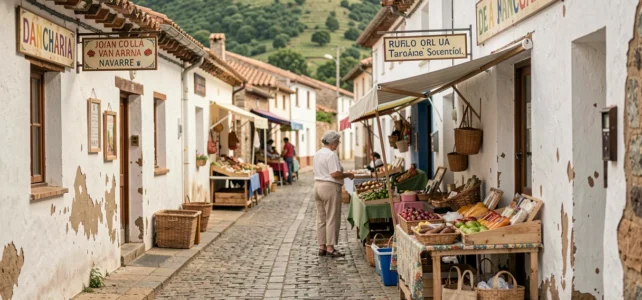
Dancharia is a hamlet attached to the municipality of Urdax, in Spanish Navarre, located a few hundred meters from the French border. This micro-village does not appear on any classic tourist map: it primarily serves as a commercial crossing point between the French Basque Country and Spain. Its interest lies in the coexistence, in a very small area, of ventas, gas stations, cider houses, and a mountainous hinterland accessible on foot.
Dancharia and the Basque border: a functioning to understand before going
Dancharia does not resemble a village in the traditional sense. There is no town center, no public square, no town hall. The place is structured around a main road lined with shops, restaurants, and gas stations. The activity relies on the price differential between France and Spain, particularly concerning tobacco, alcohol, and fuel.
This configuration attracts a steady flow of visitors from the French side, especially from Ainhoa, Sare, or the coast around Biarritz and Saint-Jean-de-Luz. The drive from Ainhoa takes a few minutes by car along a winding but well-maintained mountain road.
Parking poses a recurring problem. The parking lots, often linked to the ventas, fill up quickly on weekends and during holidays. Arriving early in the morning or on weekdays radically changes the experience. Those who wish to explore Dancharia in Spain with Hôte Antic Travel will find tips for organizing this stop within a larger loop.
Ventas de Dancharia: what the border shops really offer
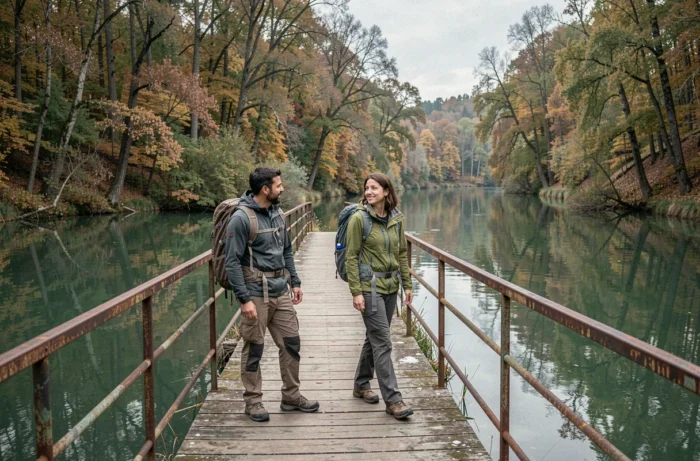
The term venta refers to a roadside shop, historically linked to cross-border exchanges. In Dancharia, the ventas primarily sell tobacco, alcohol, household linen, crockery, and Spanish food products (canned goods, charcuterie, olive oil).
The offerings are not homogeneous. Some ventas operate like small general supermarkets. Others specialize in a single type of product. Prices generally remain lower than those in France, but the gap varies by category.
Fuel in Dancharia: an advantage to check on-site
The gas stations in Dancharia often display prices per liter lower than those of nearby French stations. The actual savings depend on the day and the chosen station. The differences fluctuate, and sometimes certain Spanish pumps are only slightly cheaper than their French counterparts.
Comparing prices displayed on the same day, rather than assuming a systematic advantage, avoids disappointments. Mobile fuel comparison apps now cover the Spanish stations near the border.
Basque cider house and gastronomy in Urdax: beyond the ventas
Dancharia is also distinguished by its cider-making tradition. The Kupela cider house, located on-site, offers a traditional Basque meal accompanied by cider drawn from the barrel. This format, called sagardotegi in Basque, follows a set menu: cod omelet, grilled beef rib, sheep cheese, nuts, and unlimited cider.
This gastronomic ritual is nothing like a classic restaurant dinner. People eat standing up or at long shared tables, and they get up to refill their glasses directly from the cider stream coming from the barrel. The atmosphere is collective, noisy, and friendly.
- The cider house menu is generally fixed price, simplifying the budget
- The traditional cider season runs from January to April, but some cider houses open for a good part of the year
- Reservations are recommended on weekends, especially during holiday periods
Visit loop between Dancharia, Ainhoa, and the Sare caves
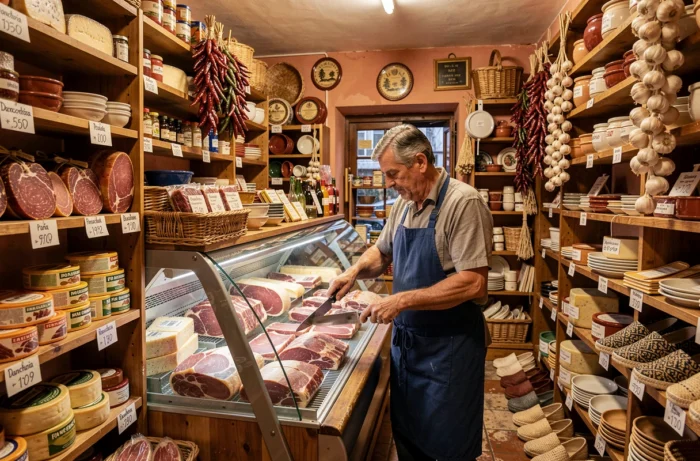
Reducing Dancharia to a commercial stop would overlook its immediate surroundings. The hamlet is part of a network of villages and natural sites that can be easily visited in a day.
Ainhoa, listed among the most beautiful villages in France, is located a few kilometers on the French side. Its red and white half-timbered houses, typical of Labourd, deserve a stop of an hour or two. The village is compact, with no excessive crowds outside of the peak summer season.
The Sare caves, located a bit further north, offer an underground visit focused on Basque geology and mythology. The site is family-friendly and remains accessible even in rainy weather, making it a logical complement to a morning spent in Dancharia.
- Dancharia for shopping and lunch at the cider house
- Ainhoa for Basque architecture and walking
- The Sare caves for a cultural and geological visit
- Urdax, the parent municipality of Dancharia, also has a monastery and less frequented caves
Linking the stops without traffic jams
The roads between these points are narrow and hilly. In summer, queues of cars form as you approach Dancharia between late morning and mid-afternoon. Starting with Sare or Ainhoa in the morning and heading down to Dancharia after the peak helps to smooth out the day.
The return to the Basque coast (Biarritz, Saint-Jean-de-Luz) takes between thirty and forty-five minutes depending on the chosen route and traffic density. The road via the Saint-Ignace pass adds an unobstructed view of La Rhune and the Atlantic coast.
Dancharia works better as an integrated stop in a Basque circuit than as an isolated destination. The charm of the place lies in its threshold position: neither entirely Spanish nor entirely French, a place where the border is crossed without thinking, between a full tank of gas and a glass of cider.