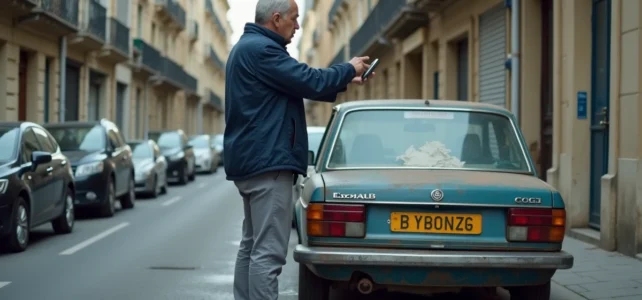
A vehicle parked in the same spot for weeks takes up a space, disrupts traffic, or degrades the living environment. Reporting a nuisance vehicle requires contacting the right authority and providing the correct information; otherwise, the request may go unanswered. Depending on whether it is on public roads, in a condominium parking lot, or on private property, the procedure, the competent authority, and the timeframes can vary significantly.
Public road, condominium, residence: the right contact based on location
The first instinct – calling the town hall – does not work in all cases. The competent authority directly depends on the legal status of the location where the vehicle is immobilized.
| Parking Location | Main Contact | Expected Action |
|---|---|---|
| Public road (roadway, sidewalk) | Town hall / municipal or national police | Observation by an assistant judicial police officer (APJA), possible ticketing, possible towing |
| Condominium parking | Property manager or building manager | Formal notice to the vehicle owner, then contacting law enforcement if necessary |
| Private residence (land, driveway) | Landowner, then judicial court | Friendly request, then legal action to obtain removal |
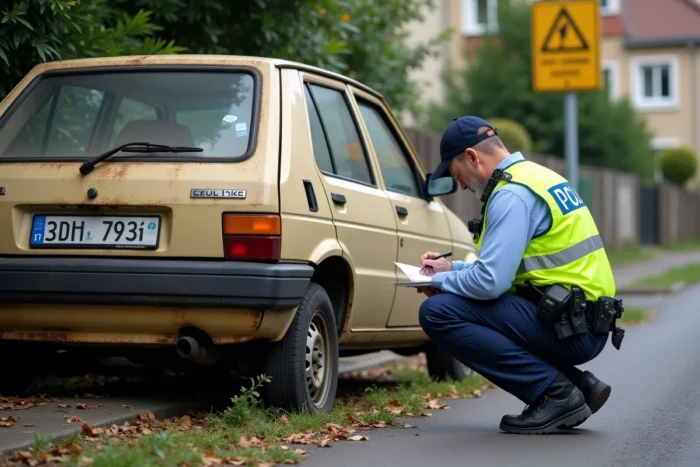
On public roads, the procedure is the most straightforward: an officer observes the presence of the vehicle and then returns after seven days to check that it has not moved. If the vehicle is still there, it is ticketed and may be towed.
In a condominium, law enforcement cannot immediately intervene in a private space. The property manager must first attempt to identify the vehicle owner and send them a formal notice. Only in case of failure can the police be called, which significantly lengthens the timeframes. Before taking any steps, it is useful to know how to effectively report a nuisance vehicle to adapt your strategy to the context.
Nuisance vehicle or wreck: legal distinction and practical consequences
A nuisance vehicle and a wreck fall under different legal frameworks. Confusing the two delays the handling and directs you to the wrong contact.
The nuisance vehicle is a vehicle in a drivable condition, parked in the same spot for more than seven consecutive days on public roads. It falls under the category of abusive parking as defined by the Highway Code.
The wreck refers to an abandoned vehicle, incapable of moving (flat tires, broken windows, advanced rust) and destined for destruction. The removal procedure differs: a wreck can be removed without waiting for the seven-day period, as it poses a risk to public health or safety.
- If the vehicle has all four wheels, readable plates, and appears mechanically functional, it is likely a nuisance vehicle – report it to the town hall or municipal police.
- If the vehicle is damaged, without plates, or clearly out of use, report it as a wreck to the town hall’s cleanliness service or via your municipality’s dedicated form.
- If the vehicle is stolen or burned, a judicial procedure is initiated alongside the removal (Article R. 325-13 of the Highway Code).
The distinction has a direct consequence on the timeframe: a wreck can be removed without a seven-day notice, while the nuisance vehicle requires two observations spaced one week apart.
Building a solid case: evidence that speeds up processing
A vague report (“there’s a car parked for a long time”) is unlikely to lead to a quick resolution. Municipal services and the municipal police handle requests based on the quality of the information provided.
Timestamped evidence is the main lever. Photograph the vehicle with a visible time marker (today’s newspaper, timestamp from your phone) at several days’ intervals. Each photo should clearly show the license plate, the exact location, and the general condition of the vehicle.
- Timestamped photos of the vehicle taken at least seven days apart, showing that it has not moved
- Complete and readable license plate number
- Precise address or geolocation of the location
- Description of the vehicle’s condition (tires, bodywork, presence of accumulated dust or leaves)
- Written testimonies from neighbors if possible, with dates
This file accompanies the report, whether made at the town hall, by phone, or through an online platform. Several municipalities now offer digital forms with registration numbers, allowing you to track the progress of the request and follow up if the processing time is prolonged.
Online reporting and tracking: municipal tools that change the game
Reporting by mail or at the counter is still possible, but more and more town halls are setting up dedicated digital platforms. These tools formalize the request and generate a tracking number, making the process traceable.
The online form generally asks for the parking address, a description of the vehicle, the license plate number, and the option to attach photos. Once the report is registered, the town hall forwards the file to the municipal police for on-site verification.
The advantage of formalized reporting is twofold. It creates an administrative record that can be used for follow-ups, and it forces the service to register the request in a processing circuit. A phone call, no matter how detailed, does not always leave a trace that can be used.
If your municipality does not have an online platform, send a registered letter to the mayor enclosing the photographic evidence. This letter triggers an obligation for the administration to respond.
The time between the first report and the actual removal varies by municipality and the workload of the services. Consistency in follow-up – following up after two weeks without a response, asking for the file number – remains the factor that distinguishes quickly processed reports from those that stagnate.