
Pain in the buttock associated with radiation down the leg most often corresponds to irritation of the sciatic nerve. This nerve, the largest in the human body, originates from the lumbar and sacral nerve roots (L4 to S3), traverses the buttock region deeply, and then descends to the foot. When one of its roots or the nerve trunk itself is compressed, the pain follows a characteristic path that medicine calls sciatica.
Extra-spinal compression of the sciatic nerve: the diagnostic trap
Most content on sciatica describes a single scenario: a herniated disc compresses a nerve root in the spine. This mechanism exists, but it masks a more nuanced reality. Recent studies show that extra-spinal compression of the sciatic nerve, meaning outside the spine, is much more common than previously thought.
The most common case involves the piriformis muscle. This small deep muscle in the buttock connects the sacrum to the femur. The sciatic nerve passes just below it, and in some people, directly through its fibers. When the piriformis contracts or thickens, it compresses the nerve and reproduces pain almost identical to that of a herniated disc.
What is called the piriformis syndrome represents a significant portion of cases mistakenly diagnosed as classic disc-related sciatica. The confusion is logical: the pain starts in the buttock, descends into the leg, and worsens with prolonged sitting. Only a targeted clinical examination or an MRI can make the distinction.
Understanding buttock pain and sciatica from this perspective changes management: treating a hernia that is not the real cause of the pain delays healing, sometimes by several months.

Herniated disc and sciatica: the precise spinal mechanism
When the cause is indeed spinal, the mechanism follows a simple mechanical logic. The intervertebral disc, located between two vertebrae, acts as a shock absorber. Its central part (the nucleus pulposus) is gelatinous. Under the effect of repeated stress or a sudden effort, the fibrous envelope of the disc cracks and the nucleus bulges backward.
This bulge, the herniated disc, comes into contact with a nerve root in the spinal canal. The L5 or S1 root is most often affected. The irritation causes a local inflammatory reaction that amplifies the pain well beyond simple mechanical compression.
A often-overlooked point: the size of the hernia does not always correlate with the intensity of the pain. A small protrusion in a narrow spinal canal can generate severe symptoms, while a large hernia may sometimes remain silent if it does not affect any root.
Alert signals that change the game
The majority of sciatica evolves favorably within a few weeks. Certain signs necessitate urgent consultation:
- A loss of muscle strength in the foot or leg (difficulty walking on heels or toes), which may indicate a paralytic sciatica
- Urinary or intestinal disturbances associated with numbness in the perineal region, suggesting cauda equina syndrome
- Pain that does not respond to any analgesic, even morphine, characteristic of hyperalgesic sciatica requiring hospital management
These severe forms remain rare, but their rapid identification conditions the functional prognosis.
Treatment of sciatica: what recent recommendations have changed
Current management recommendations in general medicine have significantly evolved. Strict bed rest, long prescribed reflexively, is now discouraged. Maintaining appropriate physical activity accelerates recovery compared to immobilization.
The first-line treatment relies on classic analgesics and non-steroidal anti-inflammatory drugs, prescribed for a short duration. Epidural corticosteroid injections are used as a second line when pain persists after several weeks.
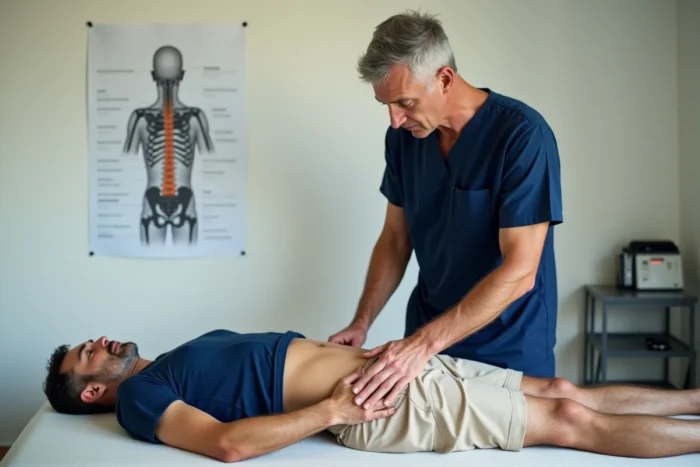
Physical therapy and nerve mobilization
Physical therapy work targets two distinct objectives depending on the origin of the compression:
- In the case of a herniated disc, McKenzie-type exercises (progressive lumbar extension) aim to recenter the disc nucleus and reduce pressure on the nerve root
- In the case of piriformis syndrome, specific stretching of the piriformis muscle and strengthening of hip stabilizers help relieve the nerve from muscular compression
- In both cases, neural mobilization techniques (sliding the nerve in its sheath) reduce tissue adhesion around the irritated nerve
Applying the wrong protocol, such as McKenzie exercises for piriformis syndrome, remains ineffective or even exacerbating. The prior differential diagnosis conditions the entire rehabilitation process.
When surgery becomes relevant
Surgical intervention concerns a minority of patients. It is primarily justified in three situations: a paralytic sciatica, cauda equina syndrome, or pain resistant to all conservative treatments after several months. The most common technique, microdiscectomy, involves removing the fragment of disc that compresses the nerve root through a minimal incision.
Tarlov cysts: a rare cause not to ignore
With the widespread use of lumbar-sacral MRIs, Tarlov cysts are increasingly being identified. These fluid-filled sacs form around the sacral nerve roots. Most are discovered incidentally and remain asymptomatic.
Some cysts cause sacral pain radiating to the buttock and leg, mimicking classic sciatica. Diagnosis relies on MRI, and management remains controversial: a neurosurgical opinion is necessary when symptoms persist despite well-conducted conservative treatment.
Buttock pain radiating down the leg does not have a single possible cause. The reflex to attribute everything to a herniated disc leads to inappropriate treatments and months of unnecessary pain. A methodical clinical examination, supplemented if necessary by imaging, remains the basis of effective management.